You Are Optimizing the Wrong Layer
A causal-stack framework for diagnosing mobile game user acquisition problems without chasing CPI, ROAS, or other surface-level symptoms.
Why Mobile Game UA Breaks When You Optimize the Wrong Layer
Most mobile game user acquisition problems are diagnosed at the wrong altitude.
Teams argue about CPI, CTR, or ROAS, but those are not causes. They are symptoms propagating up a causal stack. When you optimize at the wrong layer, you get short-term relief and long-term instability.
This post introduces a causal hierarchy for mobile game UA and explains how to reason from business impact down to root causes without collapsing into metric whack-a-mole.
The Causal Stack (Top to Bottom)
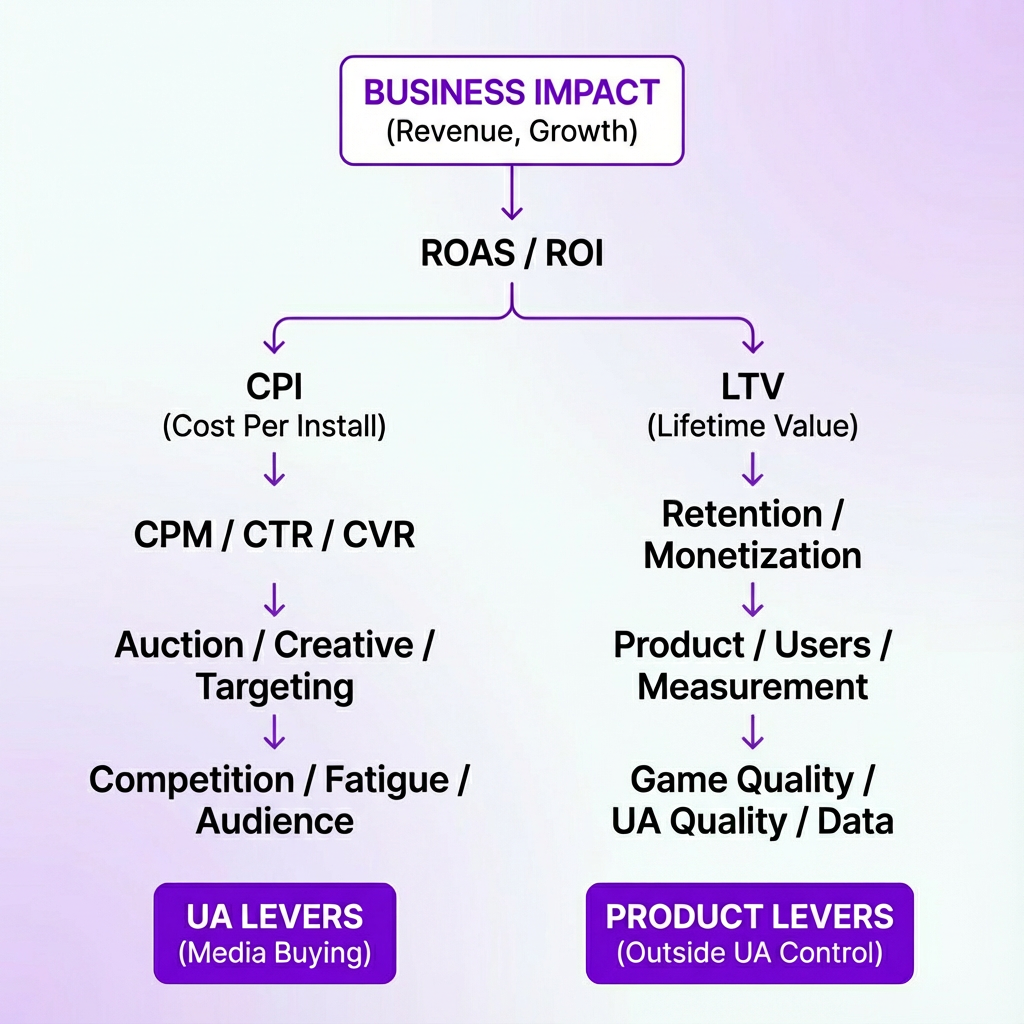
Each layer constrains the layers above it. The mistake most teams make is treating upper layers as control levers rather than indicators.
Layer 1: Business Impact (Revenue, Growth)
This is where leadership feels pain.
- Revenue misses
- Growth stalls
- Forecasts break
By the time issues reach this layer, the underlying causes are already weeks or months old. There are no fixes here, only consequences.
This layer should never be optimized directly.
Layer 2: ROAS and ROI
ROAS is where UA and finance usually meet.
When ROAS drops, the instinctive response is to cut spend, tighten targeting, or pause losers faster. Those actions often improve reported ROAS temporarily while degrading the system underneath.
ROAS is a composite outcome, not a controllable variable.
It decomposes into two independent dimensions:
- CPI (cost to acquire users)
- LTV (value of those users)
If you do not know which side moved, you are already blind.
Layer 3: CPI and LTV
This is where teams start pretending causes exist.
CPI
CPI is often treated as a primary health metric, but CPI is just a function of:
- CPM
- CTR
- CVR
Any CPI discussion that does not immediately branch into those three is incomplete.
LTV
LTV failures are rarely attributed correctly to UA.
Common misdiagnoses:
- "Traffic quality dropped"
- "Marketing scaled too fast"
Actual causes are frequently:
- Onboarding regressions
- Monetization balance changes
- Creative expectation mismatch
CPI and LTV can move independently and mask each other.
Layer 4: CPM, CTR, CVR and Retention, Monetization
This is the diagnostic layer, not the causal one.
CPM, CTR, CVR
These metrics describe how efficiently you are buying attention and converting intent.
They respond to:
- Auction pressure
- Creative performance
- Audience availability
They do not explain why those things changed.
Retention and Monetization
These metrics describe user quality after install.
They respond to:
- Product quality
- Expectation setting
- User intent alignment
When CPI improves but retention collapses, the system is signaling proxy misalignment.
Layer 5: Auction, Creative, Targeting and Product, Users, Measurement
This is where actual control begins.
Auction
- Competition density
- Seasonality
- Market maturity
- Platform delivery confidence
Rising CPMs are rarely a bidding problem. They are usually a relevance or competition problem.
Creative
- Fatigue
- Concept saturation
- Format mismatch
- Hook decay
Creative fatigue is not CTR decay alone. It is frequency saturation interacting with declining marginal engagement.
Targeting
- Audience saturation
- Over-constrained exploration
- Lookalike seed decay
Most targeting problems are created by previous optimization decisions, not bad audiences.
Product
- Onboarding friction
- Monetization balance
- Crash rate
- Content pacing
UA frequently surfaces product regressions before product analytics catches them.
Measurement
- Attribution delay
- Privacy thresholds
- Signal sparsity
Attribution delays can make healthy campaigns look broken and broken campaigns look healthy.
Layer 6: Root Conditions
This is the layer most teams never model explicitly.
Canonical root conditions that repeatedly appear across accounts:
- Competition and auction inflation
- Creative fatigue and concept exhaustion
- Audience saturation
- Learning instability from frequent edits
- Signal degradation from privacy systems
- Proxy optimization mismatch
- Product quality regressions
- Human overreaction loops
Multiple symptoms converge onto the same root condition. Treating symptoms independently guarantees oscillation.
Why Symptom-First Optimization Fails
If you fix CPI without understanding whether CPM, CTR, or CVR moved, you often:
- Narrow audiences prematurely
- Increase frequency faster
- Accelerate creative fatigue
- Reduce long-term scale
If you fix ROAS by cutting spend, you:
- Starve learning
- Lose auction position
- Destroy future efficiency
The system becomes fragile because actions are applied at the wrong layer.
The Correct Mental Model
- Upper layers are lagging indicators
- Middle layers are diagnostic signals
- Lower layers are causal levers
Healthy UA organizations reason bottom-up and act only after causal confirmation.
This is why senior media buyers think in stories, not metrics.
Why This Matters for Autonomous UA
An autonomous system cannot chase CPI or ROAS directly.
It must:
- Detect symptoms
- Map them to shared root causes
- Require evidence before activating explanations
- Optimize for system stability, not single-metric wins
That is how you avoid fixing CPI today at the cost of growth next month.
Closing Thought
If your UA strategy lives above CPM, CTR, CVR, and retention, you are managing outputs, not a system.
Growth comes from understanding which layer moved, why it moved, and whether fixing it improves the whole stack or just quiets the dashboard.